Executive Summary
Analyst bottom line: incentives are table stakes. The stronger proposition is: 'your family can live here, govern here, source here, co-invest here and be treated as a long-term relationship rather than a lead'.
Family offices have become a material private-capital channel at the same moment conventional FDI pipelines are getting narrower. UN Trade and Development's January 2026 monitor found global FDI rising in 2025, but with much of the increase routed through financial centres and with greenfield announcements down. For investment promotion agencies, that creates a practical problem: the capital most willing to back private companies, infrastructure, digital assets and long-duration real assets is often no longer sitting in the institutional channels agencies know how to cover.
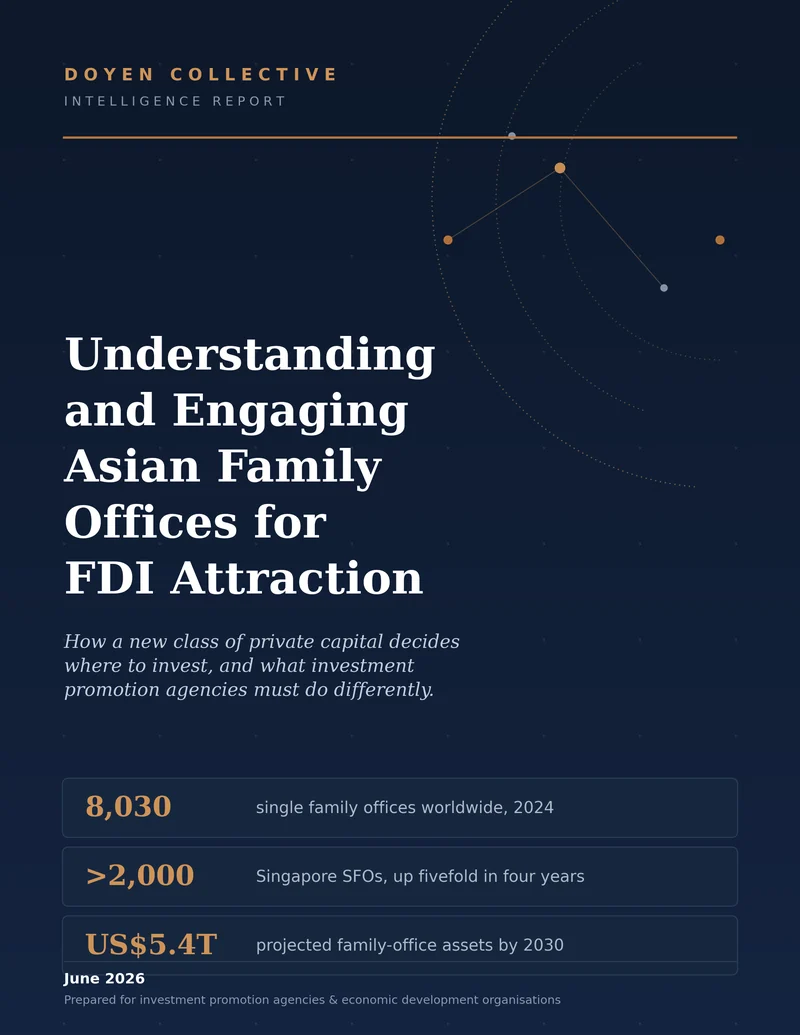
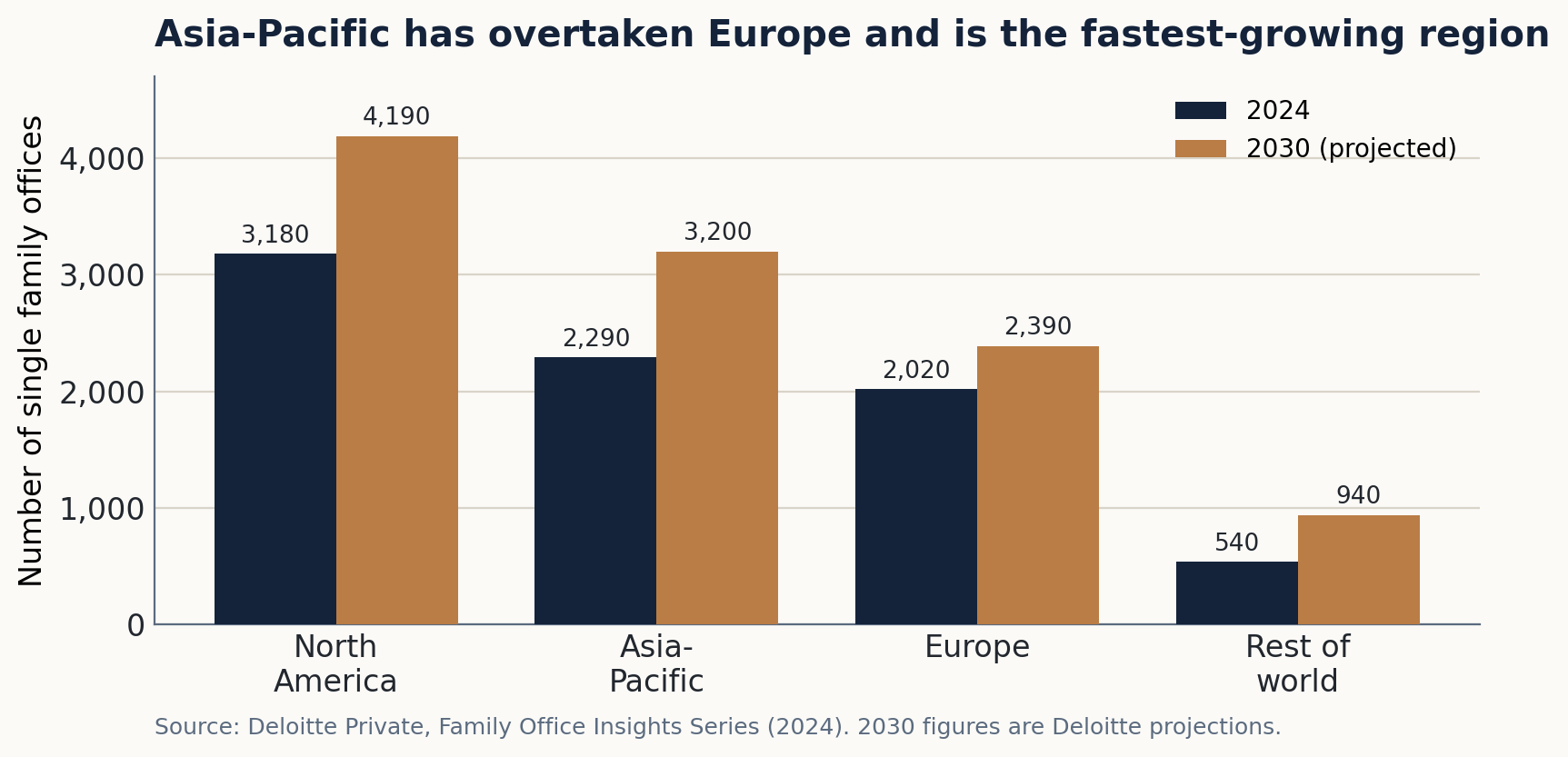
Asian family offices are an important part of that shift. Deloitte estimates roughly 8,030 single family offices worldwide in 2024, managing about US$3.1 trillion, with both figures projected to rise materially by 2030. Asia-Pacific has overtaken Europe in office count and remains the fastest-growing major region. The capital is frequently booked through Singapore or Hong Kong even when the family's commercial origin is mainland China, India, Indonesia or another Asian market.
What the agency needs to know
What the agency should do differently
1. Why This Capital Now Matters To FDI Teams
Figure 1. Public estimates understate the full private-wealth pool, but they are sufficient to show that the channel is now too large for IPAs to ignore.
A family office is the private organisation built to manage one family's financial assets, operating-business liquidity, succession, philanthropy, tax, risk and often the practical affairs of the family itself. The economic threshold is not fixed, but a dedicated single family office usually starts to make sense somewhere above US$100 million in investable assets; below that, a multi-family office or private bank platform is more common. The regulatory thresholds used by Singapore or Hong Kong are different. They are eligibility floors for tax or residency benefits, not a definition of when an office is commercially sensible.
Figure 2. Deloitte's 2024 census places Asia-Pacific ahead of Europe by office count. Rest-of-world growth is faster from a smaller base.
Implication for IPAs: The useful geography is not nationality alone. A family may be Chinese, Indian or Indonesian in origin, resident in Dubai, and managed from Singapore or Hong Kong. The adviser location often matters as much as the passport.
The FDI relevance
The case for family-office coverage is strongest where an agency is trying to attract capital into long-duration, privately negotiated assets: infrastructure, advanced manufacturing, energy-transition projects, real estate, data centres, healthcare platforms, deep technology and operating companies seeking patient minority or control capital. A family office can hold longer than a fund, can invest outside a rigid mandate and can bring operating knowledge from the family's original business.
That flexibility is also the hazard. A family office is under no obligation to deploy in a jurisdiction. It does not need to respond to a tender, does not need to meet an allocation target, and often prefers privacy to recognition. The agency must earn attention before it can sell opportunity.
Figure 3. The 2026 FDI backdrop makes curated private capital more valuable: headline growth is not translating into broad project activity.
2. The Asian Family-Office Operating Model
Asian family offices are not one archetype. The region includes founder-controlled first-generation fortunes, operating families moving liquidity out of a core business, professionalised billion-dollar platforms, next-generation-led venture investors, diaspora families and multi-family offices acting as outsourced CIOs. Treating them as one segment is the most common analytical mistake.
Who decides
The founder or controlling principal still matters more in Asia than in most Western family-office coverage models. Professional staff may build the memo, run diligence and negotiate terms, but final conviction often sits with the family member who created the wealth or with the senior family council. At the same time, institutionalisation is real: UBS's 2026 report shows many offices now use investment committees and formal performance measurement, while still showing gaps in family governance and succession planning.
Segment map for agency targeting
| Segment | What they usually want | Best agency entry point | Risk |
|---|---|---|---|
| Founder-led operating family | Control, trust, privacy, operating relevance and a clear reason the jurisdiction helps the core business or next venture. | Senior warm introduction through banker, lawyer, peer family or board-level adviser. | Pitching only the professional team and never reaching the principal. |
| Professionalised SFO | Diligence-grade opportunities, clear governance, credible local partners and low-friction execution. | CIO / CEO plus the adviser ring; provide an investment memo, not a brochure. | Being too informal or vague for institutional-grade staff. |
| Next-generation-led office | Technology, climate, impact, venture ecosystems, education, identity and a role in shaping legacy. | Curated next-gen programme, university/accelerator access, impact pipeline. | Treating heirs as guests rather than future decision-makers. |
| Diaspora family | A credible way to reconnect capital with identity, family history and local opportunity without political or execution embarrassment. | Diaspora champions, trusted local operators and aftercare team. | Over-romanticising origin ties without project discipline. |
| Multi-family office | Repeatable access to screened opportunities across several client families. | Structured partnership and recurring deal review cadence. | Assuming the MFO speaks for all underlying families. |
What this means in practice
Field signal: The most useful first meeting is rarely a direct ask for capital. It is a trust-building discussion in which the family tests whether the agency understands its constraints, can make selective introductions and will stay useful after the first visit.
3. How The Capital Is Being Deployed
Figure 4. UBS 2026 shows family-office interest clustering around AI and the physical systems that make AI investable.
The investment pattern is no longer a simple alternatives boom. It is a selective rotation into themes where families believe they can understand the asset, hold through volatility and use their own networks. In 2026, the most important signal is AI, but the more useful IPA translation is broader: AI demand is pulling capital toward data centres, power, semiconductors, cooling, digital infrastructure, automation, healthcare analytics and industrial systems.
Asia-Pacific offices are especially relevant here. UBS reports Southeast Asian family offices as the most AI-focused globally, while North Asian offices are highly technology-oriented and globally diversified. BNP Paribas/Campden's 2025 Asia-Pacific study similarly shows families reviewing liquidity, diversifying risk and sustaining interest in AI, digital infrastructure, private markets and climate-aligned investments.
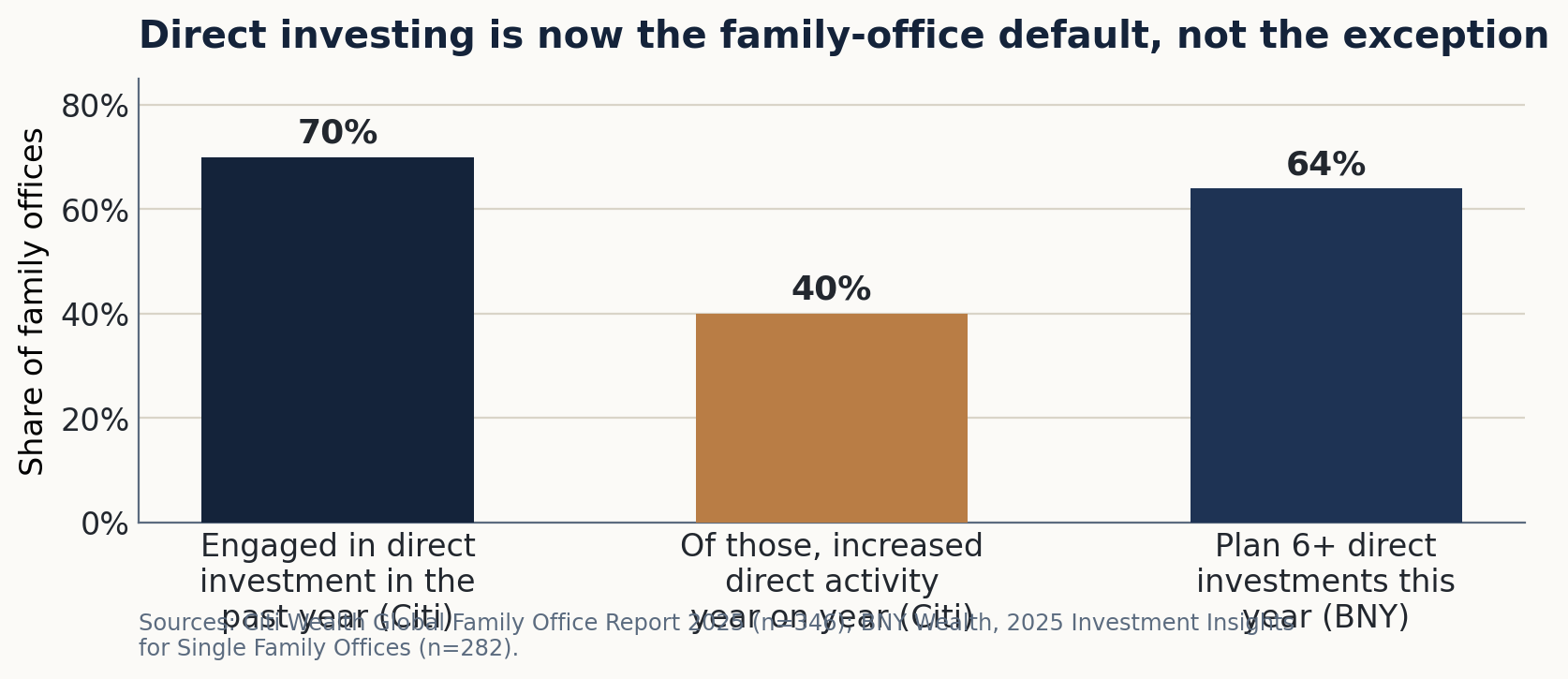
Figure 5. Direct investing is a demand signal, but the operating constraint is sourcing and diligence capacity.
Where FDI teams can offer something families actually need
| Family-office need | IPA asset that can meet it | What 'good' looks like |
|---|---|---|
| Proprietary deal flow | Curated local company, infrastructure and real-asset pipeline. | A quarterly slate with investment rationale, ownership terms, local partner map, incentives and diligence contacts. |
| Trustworthy local operators | Introductions to founders, project sponsors, universities, utilities, industrial anchors and co-investors. | Introductions are selective and sequenced; the agency does not flood the family with weak leads. |
| Execution certainty | Permitting, land, workforce, grant, tax, visa and government-navigation support. | A single accountable official owns friction until it is solved or escalated. |
| Reputation control | Screened counterparties and clear public-private messaging protocols. | The family can invest without being forced into unwanted publicity. |
| Long horizon | Assets that reward patient ownership: infrastructure, energy, life sciences, industrial platforms, strategic real estate. | The agency understands hold periods, governance rights and follow-on capital needs. |
What to avoid
4. Singapore, Hong Kong And The Hub Contest
Figure 6. The two leading Asian hubs show different kinds of evidence: Singapore publishes tax-awarded SFO counts; Hong Kong relies on commissioned market studies.
Singapore and Hong Kong matter because they demonstrate what a full family-office funnel looks like. They are not simply low-tax jurisdictions. They combine tax treatment, substance requirements, residency channels, specialist teams, adviser ecosystems, convening, next-generation programming and capital-deployment mechanisms. That is why they should be studied by any agency trying to reach Asian private capital.
Singapore: substance through tax approval
Singapore's family-office regime is anchored in fund tax incentives under Sections 13O and 13U, alongside the Economic Development Board's Global Investor Programme for qualifying principals. The practical policy lesson is conditionality: the family gets an efficient structure, but the structure is expected to create local substance through investment professionals, business spending, screening and capital deployment into eligible Singapore investments. Singapore has also tightened scrutiny after reputational concerns, while signalling in late 2025 that it would simplify parts of the application process to stay competitive.
Hong Kong: tax concession plus residency integration
Hong Kong's 2023 family-owned investment holding vehicle concession gives qualifying structures a zero profits-tax rate on qualifying transactions, subject to conditions including at least HK$240 million in specified assets managed by the eligible SFO, at least two qualified full-time employees in Hong Kong and at least HK$2 million of local operating expenditure. The stronger FDI lesson sits in integration: the New Capital Investment Entrant Scheme requires at least HK$30 million of eligible investment and has been tied more closely to family-office structures, including a March 2026 measure allowing qualifying private-company holdings linked to FIHV/SFO structures to count.
| Dimension | Singapore | Hong Kong | Agency lesson |
|---|---|---|---|
| Core mechanism | 13O / 13U fund tax incentives; GIP separately for qualifying principals. | FIHV profits-tax concession plus New CIES residency route. | Do not treat tax and residency as separate workstreams. |
| Local substance | Investment-professional headcount, local business spending, screening and capital deployment expectations. | Two qualified employees and HK$2m operating spend for FIHV concession; local service ecosystem actively convened. | The incentive should buy real local activity rather than registration alone. |
| Positioning | Stable neutral hub into ASEAN and wider Asia; strong governance and banking depth. | Gateway to mainland China, international finance centre and family legacy platform. | The proposition must cover the whole location decision. |
| Conversion tool | Singapore investment deployment and GIP employment/investment conditions. | CIES Investment Portfolio and capital-matching platform for local innovation. | Give families a route from residency interest to deployable local opportunities. |
| Strategic caution | Screening protects integrity but can slow inflow if the experience feels opaque. | Geopolitics may concern some families, but institutional design is strong. | Integrity and ease must be designed together. |
Competitive insight: An IPA outside Singapore, Hong Kong or the Gulf cannot win by copying tax rates. It can win by being more selective, more personal, better at local deal access and more credible on aftercare.
5. What Changes For Investment Promotion Agencies
Most IPAs are built around companies, not families. Their standard operating model assumes a corporate investor with a defined project, public executives, known expansion criteria, a real-estate or site-selection process, and a willingness to talk to government. Family offices invert several of those assumptions.
| Institutional investor habit | Why it misfires with families | Replacement behaviour |
|---|---|---|
| Campaign-led outreach | Families do not want to be marketed to and may interpret broad outreach as weak access. | Warm introductions through trusted advisers and peers. |
| Incentive-first pitch | Tax talk too early makes the relationship feel transactional. | Begin with family fit, trust, lifestyle, execution and relevant opportunities. |
| Generic sector deck | A family office invests through its own history, mandate and people. | Segmented thesis matched to family origin, operating expertise and generation. |
| Lead-volume metrics | The market is small, private and trust-based; volume can damage credibility. | Measure adviser relationships, warm introductions, serious mandates and capital retained. |
| Aftercare as support | Family referrals are one of the few scalable channels into private networks. | Treat aftercare as origination and reputation management. |
A proprietary lens: the family-office FDI funnel
The hidden KPI: The best measure is not how many family offices attended an event. It is how many trusted advisers would take your call when a client asks where to deploy capital or relocate a family member.
6. The Engagement Playbook
Seven tactics that work
Meeting architecture
| Moment | Purpose | What to bring | What not to do |
|---|---|---|---|
| First warm introduction | Establish fit and discretion. | A senior relationship lead, two tailored points of relevance, no long deck. | Ask immediately for capital allocation. |
| Second meeting | Test priority sectors and family constraints. | Short investment menu, local partner map, residency or setup path. | Overload with generic projects. |
| Diligence session | Give the professional team enough to engage. | Data room, comparable deals, incentives, legal and tax contacts, implementation timeline. | Hide permitting, labour, land or political risks. |
| Principal visit | Let the family imagine living and operating in the location. | Curated meetings, schools/culture/healthcare context, family-relevant experiences. | Turn it into a public VIP tour. |
| First transaction | Create proof of execution. | Named aftercare owner, escalation path, communications protocol. | Declare victory and disappear. |
Common failure modes
7. A Twelve-Month Operating Model
The agency does not need a large new department. It needs a small senior cell with enough authority to convene government, manage discretion and package opportunities. The first year should prove capability, not chase headline volume.
| Quarter | Primary objective | Core actions | Board-level proof point |
|---|---|---|---|
| Q1 | Choose the families the jurisdiction can credibly serve. | Segment by origin, sector, generation, AUM band and relocation need. Benchmark the offer against Singapore, Hong Kong and UAE. Identify 25 priority adviser relationships. | Approved target segments and a named senior relationship owner. |
| Q2 | Earn access to the network. | Run adviser briefings in one or two hubs. Build a screened opportunity shelf. Create a principal memo and a diligence memo. Put KYC/reputation protocol in place. | At least ten warm adviser relationships and three diligence-ready opportunities. |
| Q3 | Convene and convert interest. | Host one private principal/adviser session or roadshow. Make curated introductions. Begin two to four serious family conversations with a soft-landing plan. | Two active mandates or visits with defined next steps. |
| Q4 | Close first proof and build referral loop. | Move one family toward investment, relocation, co-investment or formal scouting arrangement. Provide visible aftercare. Capture lessons and adjust target segments. | One converted transaction or strategic family relationship; peer-reference plan agreed. |
Team design
Measures that matter
| Metric | Why it matters | Bad substitute |
|---|---|---|
| Trusted adviser relationships | They control access to families and recurring deal flow. | Names in a CRM. |
| Warm introductions accepted | Shows the network is willing to put reputation behind the agency. | Cold emails sent. |
| Diligence-ready opportunities | Families need investable specifics, not economic-development slogans. | Sectors promoted. |
| First transactions or scouting mandates | Proof that the agency can convert trust into activity. | Event attendance. |
| Aftercare satisfaction and peer referrals | The highest-quality pipeline comes from families already served well. | Press coverage. |
Recommended first-year ambition: Build fewer than fifty serious relationships, pursue fewer than ten families, and convert one or two visible proof points. This market rewards precision and patience.
Sources And Method
Method
This revised edition fact-checks the original report against public sources available as of 7 June 2026. It privileges primary government sources for regulatory thresholds and official counts, and uses major financial-institution surveys for family-office behaviour where no mandatory reporting exists. Estimates are treated as indicative, not exact, because family offices are private by design and definitions vary by source.
Source quality
| Claim type | Confidence | Treatment in this report |
|---|---|---|
| Government programme thresholds, residency requirements, official application counts | High | Presented as current where sourced to government pages or parliamentary replies. |
| Family-office population and AUM estimates | Medium | Presented as estimates and attributed to the source methodology. |
| Surveyed investment intentions and asset-allocation themes | Medium | Presented as directional signals, not market-wide facts. |
| Attribution of specific IPA tactics to family-office FDI outcomes | Low | Treated as practitioner inference because public conversion data is sparse. |